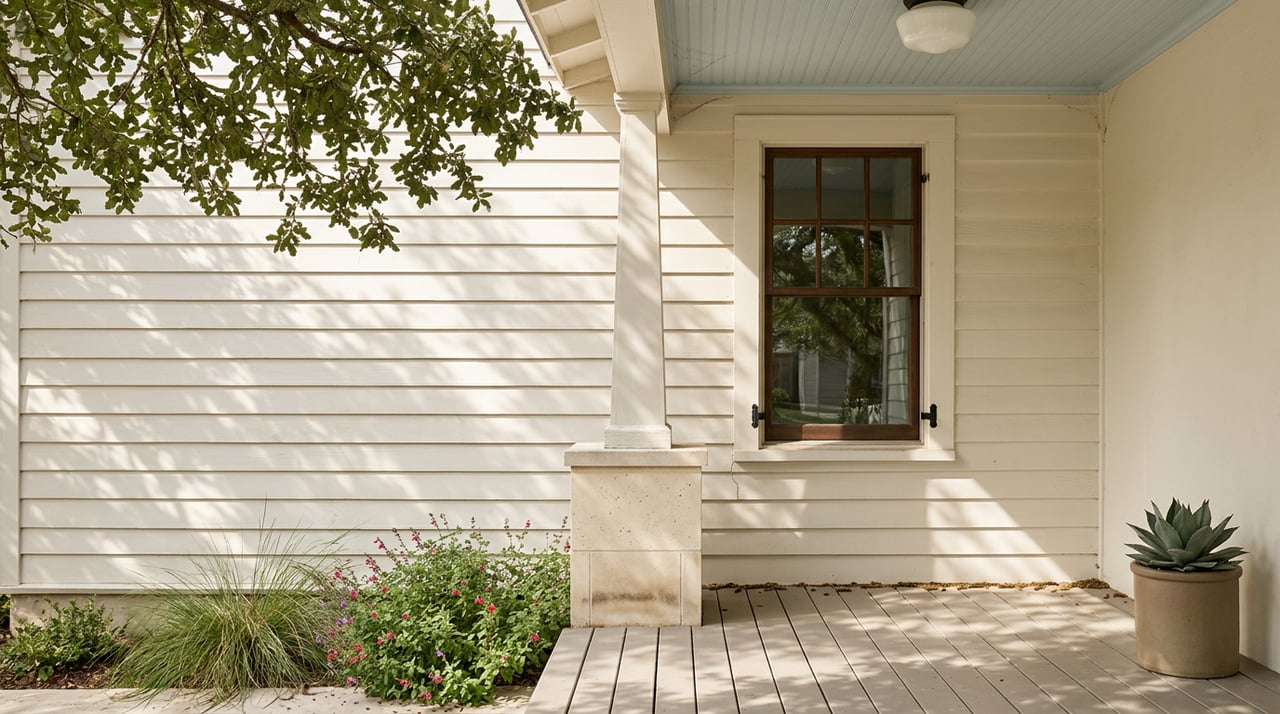
What Clarksville's Historic Label Actually Means For A Buyer In 2026
July 9, 2026
July 9, 2026
Most buyers walk into Clarksville assuming two things. That the median price tells them what a home costs, and that the neighborhood's historic designation will dictate what they can do with it after closing. Both assumptions are wrong in ways that matter at the closing table.
The median is a floor, not a fixed point. The historic label is a patchwork, not a blanket. Reading Clarksville accurately means understanding both.
Clarksville's headline price looks reasonable next to its neighbors. As of March 2026, CurbScout reported 35 active listings with a median list price of $1.6M, a median sold price of $1.1M, and 74 days on market. Homes.com pegged the March 2026 median at $1.2M with condos averaging 81 days. Read alongside Tarrytown, which sits at roughly a $2.1M median, Clarksville looks like a discount.
It is not. The honest number is per square foot, and there Clarksville frequently runs higher than Tarrytown.
| Metric (as of Q1 2026) | Clarksville | Tarrytown |
|---|---|---|
| Median sold price | ~$1.1M | ~$2.1M |
| Average price per sq ft | ~$864 | Lower |
| Typical lot | Modest | Larger |
| Walk to downtown | 5 min drive, 20 min on foot | 8–12 min drive |
| School path (AISD) | Casis or Mathews, O. Henry, Austin High | Casis, O. Henry, Austin High |
The delta reveals the mechanism. Tarrytown buyers are paying for land. Clarksville buyers are paying for location on a smaller footprint, which is why the neighborhood's price per square foot outperforms the citywide market through cycles even when total-price medians move around. A 1,400 square foot bungalow on a quarter lot near West Lynn is not a smaller version of a Tarrytown home. It is a different product with a different appreciation logic, and the scarcity underneath that logic is structural. The district was fully platted in the 1870s, boundaries are fixed by MoPac on the west and Lamar on the east, and inventory turns over slowly because longtime owners rarely list.
Here is where the friction lives. Clarksville sits inside the Old West Austin National Register Historic District, added to the National Register of Historic Places in 1976. Buyers see "National Register" in a listing description and assume every exterior change requires city approval. That reading conflates three separate designations that operate independently.
National Register listing is federal recognition. For a private homeowner not using federal tax credits, it is largely honorific. It does not by itself require design review for exterior work.
Local Historic District designation is the layer with teeth, and Clarksville does not have it. Austin currently has three Local Historic Districts: Hyde Park, Castle Hill, and Harthan Street. Property owners inside those boundaries must obtain a Certificate of Appropriateness from the Historic Landmark Commission before exterior alteration, addition, or demolition. Clarksville residents are not subject to that district-wide process.
Individual historic landmark designation is what actually binds in Clarksville, and it is parcel by parcel. A specific home on West 10th may carry local landmark status while the house next door does not. Landmarked properties trigger Historic Landmark Commission review for exterior building, demolition, and relocation permits. The City's Historic Design Standards, adopted March 2021 and modeled on the Secretary of the Interior's Standards for Rehabilitation, are the rulebook that review runs against.
This is the item to verify during option period, not after. Two identical-looking bungalows on the same block can carry entirely different renovation ceilings.
For a landmarked Clarksville property, the design standards read as a set of preferences with specific enforcement points:
For non-landmarked homes in Clarksville, none of the above applies at the district level. The neighborhood plan and standard Austin land development code govern. That distinction is the single most valuable thing a buyer can pin down before writing an offer.
The per-square-foot number is not sentiment. It is a paid-for feature set, and the feature set is walkable. Cipollina and Swedish Hill Bakery sit on West Lynn. Houndstooth Coffee is around the corner. The Whole Foods flagship on Lamar is a short walk east. Shoal Creek Trail runs the neighborhood's eastern edge and connects to Pease Park and downtown without requiring a car. The West 6th corridor absorbs evening dining without the parking friction that shapes weekend planning in most Austin neighborhoods.
None of that is replicable elsewhere at this proximity to the central business district. That is the scarcity that shows up in the price per foot.
Buyers who want Clarksville addresses without the landmarked-property variables have started to have options. The Westline community at 1408 W 9th Street has been delivering multi-level residences positioned as lock-and-leave, with completions running from Summer 2025 into Winter and Spring 2026. The Belvedere, designed by KTGY Architects with interiors by Kim Lewis Design, brings a boutique mid-rise product to Old West Austin at a connected address near Lady Bird Lake and the Butler Hike-and-Bike Trail.
These developments are the market's answer to the scarcity problem. They sit in Clarksville's fabric without carrying its individual landmark constraints, and they let buyers price walkability without inheriting a specific renovation ceiling. As of March 2026, Homes.com listed 22 active condos in the neighborhood ranging from $300,000 to $3,695,000, with condos averaging 81 days on market. That's more inventory turnover than the historic single-family stock provides, and it is where a meaningful share of relocation buyers land.
A few habits carry weight here.
Does buying in Clarksville lock me into restoring the home to its original appearance? No. The design review process, where it applies at all, is triggered by the owner initiating a construction project. It does not require proactive restoration.
If the home is on the National Register but not individually landmarked, what can I change? For most private residential work not using federal tax credits, the National Register listing does not restrict exterior modifications by itself. Standard City of Austin permitting applies. Confirm the specific parcel's status before assuming.
Is Clarksville a better long-term hold than Tarrytown? Different products, different logics. Tarrytown appreciates on land value and lot scale. Clarksville appreciates on walkability scarcity and per-square-foot pricing. Both have outperformed the broader Austin market across multiple cycles. Which is the better fit is a lifestyle question first and a portfolio question second.
How competitive is the current market? Softer than the 2021–2022 peak. CurbScout showed 4 sales in the trailing 30 days as of March 2026 and 50 in the trailing 12 months. Days on market in the 70–90 range gives well-prepared buyers real negotiating room, especially on homes with known constraints.
Clarksville rewards precision. The median will not tell you what a specific home is worth, and the historic label will not tell you what you can do with it. Both answers live at the parcel level, and getting them right before you write an offer is the difference between a clean transaction and a surprise in month four.
If you're weighing a purchase in Clarksville, or comparing it against Tarrytown, Pemberton Heights, or Old Enfield, Kim Fodor will pull the landmark status, the recent per-square-foot comps, and the honest read on what your budget actually buys on which block before you spend a Saturday touring the wrong homes.
Stay up to date on the latest real estate trends.
Get assistance in determining the current property value, crafting a competitive offer, writing and negotiating a contract, and much more. Contact me today.